
Asymmetrical Public Intelligence Overview (APIF™)
An Evidence-Based Examination of the Decisions Behind the Decision

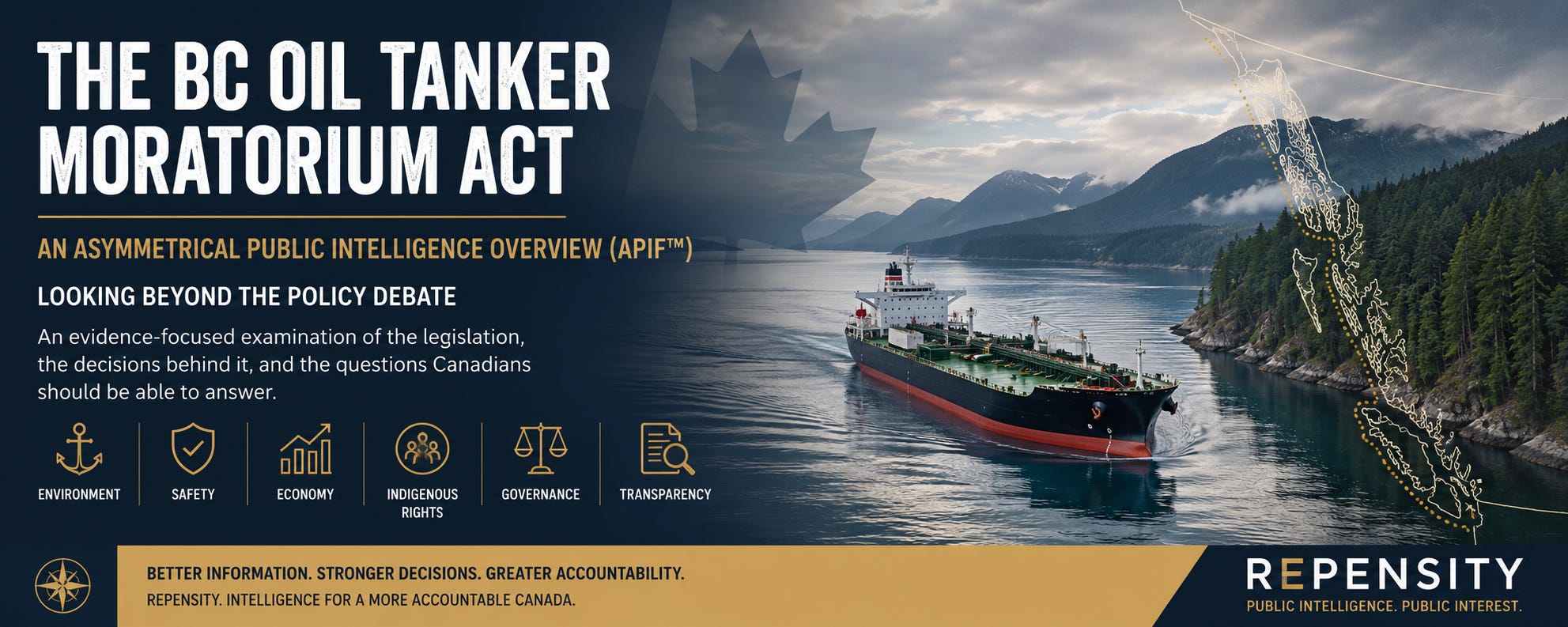
The BC Oil Tanker Moratorium Act (Bill C-48)
Looking Beyond the Policy Debate
The public discussion surrounding British Columbia’s Oil Tanker Moratorium Act has largely been framed as a choice between environmental protection and energy development. Supporters argue that the legislation protects one of Canada’s most environmentally sensitive coastlines from catastrophic oil spills. Critics contend that it unfairly restricts economic development while limiting Canada’s ability to export its natural resources.
Both perspectives focus primarily on the outcome.
Repensity examines something different.
The central question is not whether the tanker ban is right or wrong. The central question is whether Canadians have sufficient access to the evidence, analysis, and decision-making process that produced the legislation to independently evaluate whether it represents sound public policy.
That distinction changes the conversation entirely.
Rather than beginning with a political position, APIF™ begins with institutional transparency.
What the Act Does
The Oil Tanker Moratorium Act prohibits oil tankers carrying more than 12,500 metric tonnes of crude oil or persistent petroleum products from loading, unloading, or stopping at ports and marine installations located along British Columbia’s North Coast between the northern tip of Vancouver Island and the Alaska border. The legislation also prohibits the transfer of oil between vessels if the purpose is to circumvent the moratorium. Enforcement powers include mandatory reporting requirements, vessel inspections, ministerial directions, and financial penalties of up to five million dollars for non-compliance.
These provisions are clear and internally consistent.
What is less clear is how the policy itself was developed.
The APIF™ Perspective
Every significant public policy represents a chain of institutional decisions.
Somewhere before Parliament voted on Bill C-48, individuals made decisions that shaped every major provision of the legislation.
Someone determined that 12,500 metric tonnes was the appropriate threshold.
Someone determined where the geographic boundary should begin and end.
Someone concluded that the environmental risks justified the economic consequences.
Someone evaluated alternative policy options and selected this approach over others.
Those decisions did not occur by accident.
They were based on evidence, advice, modelling, consultation, political judgment, or some combination of these factors.
The question for citizens is straightforward:
Can the public independently examine that decision-making process?
The Questions That Matter
From an Asymmetrical Public Intelligence perspective, several questions immediately emerge.
Why 12,500 Metric Tonnes?
The legislation establishes an exact cargo threshold.
Why this number?
Was it derived from marine engineering studies, spill modelling, environmental risk assessments, operational experience, international standards, or political compromise?
Without understanding how this threshold was selected, Canadians cannot determine whether it represents an evidence-based limit or an administrative policy choice.
Why This Geographic Boundary?
The legislation applies to a precisely defined section of British Columbia’s North Coast.
What scientific, environmental, navigational, or economic analysis established this boundary?
Were alternative boundaries considered?
Were comparative risk assessments conducted?
The boundary itself is evidence of a decision.
The reasoning behind that decision should be transparent.
What Evidence Supported the Policy?
The Act assumes that restricting tanker traffic produces a net public benefit.
What evidence supports that conclusion?
Were comprehensive environmental studies completed?
Were economic impact assessments conducted?
Were alternative mitigation strategies evaluated?
What cost-benefit analysis was presented to Cabinet?
Without access to these materials, citizens are asked to accept the conclusion without examining the reasoning.
Ministerial Discretion
The legislation authorizes the Minister to exempt identified oil tankers where an exemption is considered essential for community or industrial resupply, or otherwise in the public interest.
This raises important governance questions.
How often have exemptions been granted?
What criteria were applied?
Were reasons published?
Were exemptions consistent across applicants?
Transparency requires more than statutory authority.
It requires public accountability for how discretionary authority is exercised.
Indigenous Consultation
The Act explicitly recognizes the constitutional rights of Indigenous peoples and requires the Minister to consider potential adverse effects when making decisions under the legislation.
Repensity supports meaningful consultation.
The public question, however, is procedural rather than political.
Which Indigenous governments were consulted?
What concerns were raised?
How were those concerns addressed?
What documentation demonstrates that the consultation process influenced the final legislation?
Consultation should leave an auditable record.
The Missing Layer
Public debate generally focuses on whether the tanker ban should exist.
APIF™ asks a different question.
Can Canadians independently verify the institutional reasoning that produced the tanker ban?
This includes access to:
Scientific risk assessments
Environmental modelling
Economic impact studies
Cabinet briefing materials
Departmental recommendations
Regulatory impact analyses
Indigenous consultation records
Lobbying activities
Parliamentary committee evidence
Alternative policy options considered during development
The strength of public policy should not depend upon trust alone.
It should rest upon transparent evidence that citizens can examine for themselves.
An Intelligence-Based Approach
Repensity does not begin with conclusions.
It begins with questions that can be answered through evidence.
If the evidence demonstrates that the legislation represents sound, transparent, evidence-based decision making, that conclusion should be welcomed.
If the evidence reveals significant gaps in analysis, transparency, or accountability, those findings deserve equal attention.
Either outcome strengthens public confidence because the conclusion follows the evidence rather than preceding it.
APIF™ Assessment
The Oil Tanker Moratorium Act is more than environmental legislation.
It is a public policy decision with significant economic, environmental, constitutional, and strategic implications.
For decisions of this magnitude, transparency should extend beyond the wording of the legislation itself.
Citizens should be able to understand not only what government decided, but how it arrived at that decision.
That is the purpose of the Asymmetrical Public Intelligence Framework.
Its objective is not to replace one narrative with another.
Its objective is to make institutional decision-making transparent, traceable, and independently verifiable.